

Shopping Cart
The organic foods products are limited


Sub Total:
$240.00
Total:
$240.00
Search Products

- Description
Nam provident sequi
Why Capital Controls® UV? 30-year history of UV water treatment solutions. De Nora experts pioneered the use of UV light to control protozoa, including Cryptosporidium and Giardia. Effective and proven for use in contaminated wastewater, drinking water and potable water. UV advanced oxidation process (AOP) tackles complex applications and contaminants of emerging concern. Highly effective solution with simple operation, maintenance, and installation including pre-engineered compact systems and superior technical features. Simple and automatic PLC based operation with intuitive navigation and display of all system parameters. Minimal operator intervention required. Reliable operation with reduced operating costs Validations and certifications include: USEPA UVDGM; DVGW UV sensors for drinking water systems Low Dose Bioassay and California Title 22 for wastewater systems per NWRI Global network of regional sales and technical support.
UV Systems successes Over 30 years ago, our experts made the initial discovery of the effectiveness of UV light for treating protozoa, including Cryptosporidium parvum and Giardia lamblia. Today, 8 billion gallons per day (30 billion liters) of water and wastewater are treated by Capital Controls UV disinfection systems featuring Sentinel, Rayox® and C3 Series reactors to support more than 30 million people worldwide, with installations in Los Angeles, Montreal, Boston, Brisbane, Singapore, and many other locations in the U.S. and around the world. Case Study Success: Indirect Potable Reuse and the Treatment of NDMA Just northeast of Phoenix, Arizona, the City of Scottsdale Water Campus was built in the 1990s and quickly became a state-of- the-art wastewater treatment/ recharge facility in the western United States. The Water Campus facility initially consisted of a 20 million gallons per day (MGD) water reclamation plant and a 10 MGD advanced water treatment plant utilizing microfiltration (MF) and reverse osmosis (RO). The upgrades to the advanced water treatment facility in 2011 and 2012 to 24 MGD included a 20 MGD UV reactor to treat NDMA and other potential contaminants. Continuing commitment to the visionary Water Campus concept is allowing Scottsdale to ensure that a reliable, long-term water supply remains available. NDMA (N-Nitroso-dimethylamine) is a semi volatile organic chemical that is a toxic and carcinogenic water contaminant created by both industrial and natural processes. Except for research purposes, NDMA is no longer intentionally produced in the United States, but through chemical reactions is still unintentionally produced and released from industrial sources such as tanneries, pesticide production facilities and rubber manufacturing plants. Listed as a priority pollutant by the EPA, it also can be an unintended byproduct at wastewater treatment plants, when wastewater is chlorinated during the disinfection process. Because of its toxicity, the Scottsdale Water Campus identified NDMA as a compound to target for treatment.
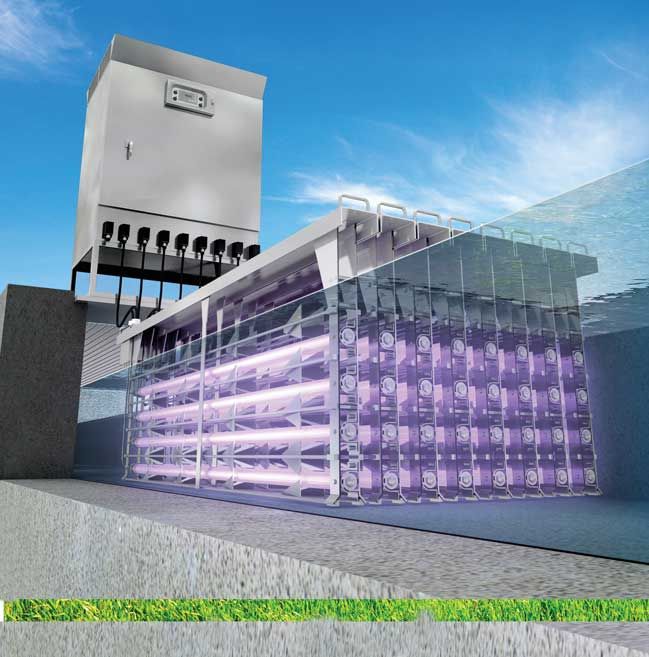
C3 series UV for wastewater & Sentinel reactor series UV for drinking water Capital Controls UV systems treat wastewater, drinking water and potable water featuring conventional UV disinfection and Advanced Oxidation Processes (AOPs). Notable applications for C3 series UV: Various water borne pathogens can be found in wastewater that can infect humans and ultimately cause sickness. MUNICIPAL WASTEWATER Total Coliform Fecal Coliform Escherichia coli WATER REUSE Poliovirus Notable applications for Sentinel reactor: Various water borne pathogens can be found in drinking water that can infect humans and ultimately cause sickness. PROTOZOA Cryptosporidium parvum Giardia lamblia VIRUS Poliovirus Hepatitis A Common Cold BACTERIA Salmonella typhy Shigella Escherichia coli Vibrio cholera C3 series UV notable advantages: EFFICIENCY AND PERFORMANCE Low pressure lamps offer superior disinfection efficiency. Fully automated dose pacing allows, variable lamp output in real-time for optimum energy and disinfection efficiency. Flood resistant modules are IP68/NEMA 6P-rated. Tubular weir offers smaller footprint than traditional serpentine weir, resulting in more uniform channel velocity profile for better dose distribution. The C3500 Series can be configured from 2 to 8 lamps per rack, 1 to 12 racks per bank and up to 5 banks per channel and any number of parallel channels. Systems are generally installed in concrete channels but smaller packaged systems up to 12 lamps can be installed in a stainless-steel channel. Sentinel reactor series UV notable advantages: LOWER OPEX Medium pressure lamps require fewer lamps, less manpower and operating costs to maintain: THE ADVANTAGE OF MEDIUM PRESSURE LAMPS Lower capital cost on lamp procurement and intensity sensors. Lamps can be turned off and/or down within a reactor resulting in lower operating power consuption. Automated quartz cleaning system results in lower cost and maintenance labor Small footprint, which is beneficial for limited spaces and retrofits.